



E-ISSN 2300-0163 (ONLINE)
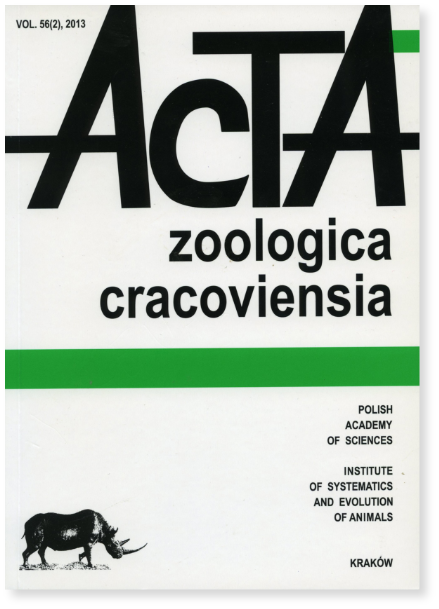
Acta Zoologica Cracoviensia
Acta Zoologica Cracoviensia is an international journal that includes papers of general interest on the systematics, phylogeny, biogeography, ecology and paleontology of terrestrial and fresh-water animals worldwide. All papers are subject to peer reviews. There are no publication charges for authors.
ARTICLESAbout the journal
Since 2018 Acta Zoologica Cracoviensia is an electronic-only Open Access journal distributed under the terms of Creative Commons Attribution License (CC-BY) which permits any use, distribution, and reproduction in any medium, provided the original author(s) and the source are properly cited. ISSN of the printed version (2299-6060) is valid for back volumes only.
Indexed in: BIOSIS Previews, Zoological Record, AGRO, Index Copernicus International, PBN – Polska Bibliografia Naukowa. Polish Ministry of Science and Higher Education ranking (2019): 20 points. Index Copernicus (2017): 90.26 points.
Acta Zoologica Cracoviensia has been awarded funding in the competition „Support for scientific journals 2019-2020” organized by the Ministry of Science and Higher Education in Poland.
Editorial Staff and Board
Editor-in-Chief
Ewa KrzemińskaInstitute of Systematics and Evolution of Animals, Polish Academy of Sciences
Kraków, Poland
Assistant Editor
Katarzyna KozakiewiczInstitute of Systematics and Evolution of Animals,
Kraków, Poland
Technical Editor
Ewa Żychowska
Kraków, Poland
Language Editor
Paweł Matus
Kraków, Poland
Adam Nadachowski
Palaeology, Mammalia
Palaeoentomology,
Palaeontology, Crustacea
Entomology,
Entomology,
Waldemar Celary
Kielce, Poland
Tervuren, Belgium
Paris, France
Ljubljana, Slovenia
Kraków, Poland
Stuttgart, Germany
Southampton, United Kingdom
Katowice, Poland
Moscow, Russia
Kimstad, Sweden
Bournemouth, United Kingdom
Madrid, Spain
Kraków, Poland
Peer review

Publication Ethics
Publication Ethics and Malpractice Statement
The publishing ethics of the Acta zoologica cracoviensia follow the relevant guidelines of the Committe on Publication Ethics (COPE)Responsibility of the Authors
Authors are invited to publish their results under condition that the articles shall be liable for the truthfulness, reliability, completeness and adequacy of the information. Authors are required to agree that their paper will be published in open access under the Creative Commons Attribution License (CC BY 4.0) license.Authors are responsible for the fairness and correctness of the research disclosed. Unsupported statements and conclusions, falsification and manipulation of the data are not ethical and therefore unacceptable. In particular the Authors must certify that:
- the manuscript submitted is their original work
- the manuscript is not currently being considered for publication in other journal;
- the manuscript has not been published before, also partially.
To counteract plagiarism, every piece of information provided by other publication should be given credit to, and a literal quotation should be clearly denoted as such. Unpublished information provided by a person not being an author can be quoted only if this person expressed his/her consent in writing. Cases of so called guest authorship or ghost writing are non ethical and unacceptable. Authors of an article are only those who took part in working up the idea, in planning and conducting the research, and in the manuscript preparation. All participating authors must define their share in the manusript preparation, and each author must provide a signed agreement for submission to the Acta zoologica cracoviensia.
Responsibility of the Editorial Board
The decision on acceptance, revision or rejection of the manuscript is undertaken by the Editorial Board of the Acta zoologica cracoviensia. The main factors taken under consideration are: the scientific quality and importance of the paper, its originality, clarity and relevance to publication's scope.The Editorial Board cares for avoiding plagiarism, ghost writing and guest authorship. Any case of such malpractice disclosed and directed to the Board is treated according to the guidelines under http://publicationethics.org/resources/guidelines. The Authors are informed on the claims in writing and are asked for explanation. Unanswered claims are directed further to the institution in which the Authors are afiliated.
The manuscript accepted by two reviewers is further processed for publication. Necessity of minor or major revision is directed in writing to the Authors. Two negative reviews result in rejection of the manuscript, and this decision is expressed in writing as soon as possible.
Responsibility of Reviewers
The manuscript submitted to the Acta zoologica cracoviensia will be reviewed by two independent, external experts. They should declare any conflicts of interests. According to the double blind policy of our journal, the identities of the Reviewers and of the Authors remain unknown to each other.The contents of the manuscript is confidential. The Reviewers can discuss it only with the members of the Editorial Board and must not refer it to third parties, or make use of the results, conclusions and opinions expressed in the submitted paper until its publication.
Reviewers should focus first of all on scientific quality of the manuscript. Their review must be objective and they are asked to be polite and constructive in their reports. Reports that may be insulting or uninformative will be declined.
The main criteria in the reviewing process are ther scientific value of the manuscript and its originality. The main concept or hypothesis should be clearly expressed, and the methods should be accordingly tailored; the conclusions based on the results obtained. The references cited must be relevant and up to date. Further detailed information in the reviewing process is provided under the Information to the Authors.
Suspected cases of plagiarism, of ghost writing or guest authorship should be disclosed to the Editorial Board; the texts showing these malpractices should be extracted and commented upon.
Counteracting the plagiarism
Plagiarism in all its forms is considered unethical behaviour. In cases of alleged or proven scientific misconduct or plagiarism concerning the text, data, or results, the Editorial Board will take all reasonable steps to clarify the situation. The Authors are informed on the claims in writing and are asked for explanation. Unanswered claims are directed further to the institution in which the Authors are afiliated. Further, depending on the severity of a given case of misconduct, there follows publication of an erratum, clarification or, in the most severe case, the retraction of the affected work.